Showing posts with label design. Show all posts

Tuesday, July 08, 2008

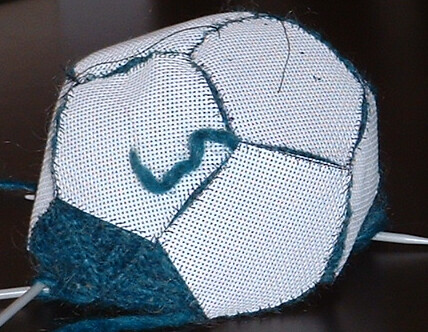
Dodecahedron basket

Looking back at the blog's posts, I realized that I forgot to write about my stitch 'n bitch one-skein swap object from January. Since I'm not feeling terribly inspired in this heat, I thought I'd look back at this project.

The basket had a number of sources of inspiration: I got the pentagon idea from Knitting Nature, from this project, and from this pattern. Essentially, it's the knit soccer ball with the 12th pentagon missing.


The basket was knit with Brown Sheep Lamb's Pride chunky and lined using some quilting cotton. I used Vinyl-Weave as interfacing. Fortunately, cutting the sheet into pentagons was fairly easy.


I've been sorting through our photos from our trip to Europe (we visited Germany, France and the Czech Republic). We had a fantastic time in Berlin.

charlottenburg palace grounds

The Charlottenburg Palace was one of the first sites we visited upon arriving in the city, which was worth seeing for the grounds alone.

Sunday, March 09, 2008

Gloria/Pinwheel Hybrid

I spent my precious knitting time this week figuring out the construction of Hanne Falkenberg's Gloria, and swatching a kiddie-sized version of my own hybrid of the original I thought was absolutely stunning in Ribbels' window, and the very popular Pinwheel Sweaters for Women and Children by Shelley Mackie which is a free pattern from Elann. (To be honest I was kind of meh about the pinwheel until I saw this version. Wow.)
What I think I know about Gloria:
1. The upper back is not part of the circle. Evidence here.
2. Stitches are cast on, stitches at the bottom of the upper back are picked up, and more stitches are cast on. The resulting large number of stitches are knit back and forth in a texture pattern with increases placed at the armpit region (like on the Sunrise Circle Jacket by Kate Gilbert, available for free on the Knitting Daily Website). Evidence for these conclusions can be found here.
3. I think that the front and back shoulders are seamed together and stitches are picked up in the resulting holes for the sleeves. I also think that somehow stitches are picked up for the collar or the collar is sewn in place.
4. The texture pattern, oh the lovely texture pattern that plays off of differences in the shades in the yarns used. I looked at some swatches here(#1) and here(#2), and some of it is definitely garter stitch with two different colors that are swapped on each row. Like dark is knit on RS and light is knit on WS. There is another texture pattern at play here, as can be seen in swatch #2, but I don't know what it is, and I don't really care either. I think it's used on the collar because it dosen't look so bumpy as the 'wrong side' of garter stitch would. Or the majority of the sweater is knit in this texture except for the upper back. I don't care so much because I figured out enough to modify the pinwheel to my tastes.

All I did was work the pinwheel in garter stitch while alternating colors every row. Easy.
Now some people in internet-land say they prefer Gloria to traditional pinwheel sweaters
because of the better fit. I think that all that's needed to correct this issue is proper sleeve placement. I'm guessing for the kid version, because children grow and the the armholes will eventually be in the right place anyways. But for my version I will swatch and block, and determine armhole distance from my favourite t-shirts, and incorporate minimal ease into the placement.

First up: the yarns:
starting at the top, clockwise, we have Lang Yarns Soft Shetland color 09 (Purple Charcoal), color 08 (Wine) and some grey Frankengarn Naturstrickwolle in a slightly lighter grey than I'm
using for Trud. (I was thinking legwarmers at the time of purchase. Oh well...). Now for a rant about 'standards' for needle sizes. The Soft Shetland recommends a 5.5 mm needle for a yarn that weighs in at 284 yards/100g. This is lighter than worsted weight, using Cascade 220 as a benchmark for a worsted weight yarn (220 yards/100g). What big needles! Now the Frankengarn company recommends 3.5-4 mm needles for their stuff which weighs in at
218 yards/100g. I would call this a worsted weight, what tiny needles! These days I completely disregard manufacturer recommendations when choosing yarn and instead go with yardage/weight. Anyways, I'm completely digressing. I LOVE the Frankengarn, and while the Soft Shetland is pretty to look at and soft in the ball, I find it 'ropey' to knit with. And not so elastic. I hope it softens up with a wash. I figured it would be OK for baby/kid gear because it's a superwash wool.

Anyways, here's how far I've gotten.
I think it looks pretty good, and the interplay of color with garter stitch has given the desired effect. Not to mention that these random yarns I had sitting in the stash look Falkenberg-esque. I eliminated the yarn-over increases, and I didn't like the look of kfb increases on the Lara Pinwheel Jacket (similar pattern, same designer, also free on Elann.com)
so instead I opted for something more invisible: Elizabeth Zimmerman's 'Make 1' described on page 16 of Knitting Workshop. You basically drop a twisted loop of yarn on the needle and just keep on knitting. Easy, fast, not fussy, no gaping holes, no funny twists. And I'm switching the colored wools every 10 rows, but not the grey because I have ~ twice as much gray than the colors combined.

I like it.

Now imagine, as happy as I am with the 'right side' how surprised I was when I flipped the thing over and looked at the 'wrong side'.

Ignore the tails. You can see swirls of color where the increases were made, because they were not picked up from the grey row below. Now I like the 'wrong side' better than the 'right side'!
If I weave in the ends nicely, I'll have something the neither of the model patterns had: 100 %
reversibility!

Ivanova

Sunday, March 02, 2008

One month, two conferences, and two countries later...

I did a LOT of running around, and had nearly no time for knitting except on ridiculously long
train rides, but I managed to make decent progress on my cape. Here's the full-body-so-far shot:
I am using the vague-ish instructions from Barbara Walker's Knitting from the top.
The idea is that a cape/cloak is just a raglan that does not separate at the underarm for sleeves.
Simple enough, I wrote out instructions for a top-down raglan cloak that includes some cable panels from Elsebeth Lavold's Viking Patterns for Knitting on the front edges, (s-hitches from Arde, p. 73), raglan non-sleeve (wide panel with little lattice, p. 51), and the back (Vigdis pattern, p.81 over 24 stitches). Here's some detail shots of the cables in the order listed above.


I am finding that the Lamb's Pride Worsted has great stitch definition even though I am knitting at a ridiculously loose gauge in order to felt this sucker, so I feel confident that the
cables will survive the felting process. I never realized what a good-value cable-knitting yarn this was, and I'll probably use it again for sweaters. I just wish the mohair was less scratchy, but I can put up with a bit of scratch.

One good (or bad) thing about conferences is that the organizers tend to put random people of the same gender together in my hotel room. Imagine my surprise when I arrived in my hotel room in a tiny university town in the Netherlands to a pile of stuff on one bed including a pair of 3.5 mm straight needles with some fingering weight pink merino knitted into perfect teeny tiny stitches. A knitter! Of all the random conference attendees I was paired with, they put me up with another knitter. Needless to say, some yarn browsing took place in the 2 hours between the end of the conferences and catching our trains back. I finally saw some Hanne Falkenberg kits up close, and they are gorgeous! Too bad I can't justify spending 100 euros (about 150 dollars) on a kit. My favourites in the shop were Gloria shown in the colors I linked to, and Jazz. The pictures do not do the kits justice. But still, they are prohibitively expensive, so my new shopping buddy said I should take the mental picture for inspiration, and knit my own version with what I've got available.

I also had the good fortune of sharing a room with a knitter in Berlin, and we went to a yarn shop on Oranienstrasse (in the very cool Kreuzberg district) and I picked up a few balls of some no-name single ply lambswool in order to make my take on Gloria. On the overly long train ride from Berlin to Hannover (my roomie's transfer point) she taught me how to purl continental style. I was on a purl row. It took me 2 hours (!) to do one row. I guess I'll have to practice, and track her down for lessons on how to knit continental style. She watched me knit 'British-style' and shook her head and said "I just don't see how you can do that." Different strokes for different folks, I guess.

Here's a picture of my circular jacket yarns all nestled together:

I think it'll work (I hope!) and I'll cast on after I try a kiddie-version for the soon to be expected
cousin's kid. They are two different colors of no-name-provided German lambswool in an aran weight from somewhere near Hamburg (according to the shop employee) in a greyish lavender and petrol blue solid, paired with some Fleece Artist Kid Aran in the Marine colorway.
I'll be basing the construction on one of the 8-million free pinwheel jackets from the Elann website by Shelley Mackie but I may throw in a texture pattern like on Gloria. And I will make the sleeves striped. I particularly like this version of the pinwheel jacket, so I'll just let the ideas mingle until I have the time to cast on. I'll test texture patterns in my collection of purpley Soft Shetland balls and medium gray merino for the kiddie version.

Ivanova

Sunday, February 03, 2008

I "felt" like experimenting...

This week I decided to finally try felting. I am starting to plan my next vacation getaway to a medieval festival in May, and my husband commented that we would most likely by camping out. Probably in period gear. And if we don't camp out and get a hotel room, May is still kind of cold and damp! So I decided I needed a wool cloak. I started looking at general cloak designs, and there are some really nice LOTR inspired patterns available here. Hunt around the links, this site is a nice time suck if you're into that sort of thing. Unfortunately the wool fabrics available at the local department store fabric section kind of suck. And forget going to a fabric shop, there isn't one! (At least not a good one). And, sure, there's always Ebay, but I'd rather have something a little more inspired (and complicated) than a plain piece of gray wool draped from the shoulders with some sort of hood sewn in.

So I figured I'd felt my own after knitting it! Of course it will be cabled, so I wanted to see a) how a felted fabric looks in terms of stitch definition (and loss thereof) and b) how texture holds up to the felting process. I know it can be done nicely because I saw a felted cabled handbag pattern in the winter 2007 issue of Interweave Knits. Here's one example - very nice!

So I started with some DK merino (Frankengarn naturstrickwolle) and tried out the Dragon Scale pattern from Barbara Walker #2. I hand felted with hot soapy water and it turned into this:
Little to no stitch definition! And it's a nice stiff but light fabric, not too bad for a cloak.
I knitted it up on my Denise 11's (they're bigger than the standard US 11). I also hand-felted for about 20 minutes. For the inquiring minds, this yarn is a 2-ply. I heard somewhere that plied yarns felt cables better, but the down-side to using this stuff for the cloak is that I'd have to buy more yarn! You should have seen my husband's face when he heard this. He cringed! I guess the wool is sort of taking over our apartment. So I dug through my Christmas stash and unearthed the cones of Lamb's Pride Worsted in a dark green color. I certainly have enough of it!

I read on Knitter's Review that the ideal gauge for felting LPW is 3 sts/in. I get 3.8 sts/in on Denise 10 1/2's (smaller than standard) and 3 sts/in on Denise 11's (bigger than standard). So I knitted up a simple cabled close-loop and braid pattern (made up from my head) and hand felted both swatches. Here's the before and after pics.
This is the one done on Denise 10 1/2 needles. I only got about 15 % shrinkage in length after hand-felting and I felt it had not lost enough stitch definition. So I boiled it and agitated it in boiling water. Not a lick of difference was noticeable in size or loss of stitch definition. It fuzzed up a fair bit though. It's nice and thick, with a little bit of sproing left from the knitted fabric and the cables still show. Some dye was shed in the boiling process, but the vast color difference in the pics is due to the different lighting conditions. The top photo has the most accurate color, and the color shedding isn't noticeable in the boiled swatch.
This one was done on Denise 11's. The fabric was VERY loose before felting. I found it hard to keep the tension even when knitting the cables, so I got a hole (circled on the center picture) that didn't felt. I guess the Murphy's Law of felting is really true after all. I got 14 % length shrinkage with vigorous hand-felting, and it still retains stitch definition. I figure my best bet is to use the 10 1/2 needles because I get a nicer looking fabric in the end of it all.

So now for the pattern choices - I could not find any for a knitted felted cloak! There are a few knitted cloak patterns, and examples can be found by googling and surfing Ravelry. This one is nice, but it's from a Finnish book. The book is kindof expensive too. This one's okay, but not really what I had in mind. Now this one has the right shaping and would look reasonably historically accurate. I figured out by reading the blog of the flickr account I directed you towards that it is a raglan-shaped cloak, knit from the bottom up. So I popped out my Barbara Walker's Knitting from the Top and lo and behold there were vague-ish instructions for how to turn a top-down cardi into a cloak/cape. I've already picked out my Viking Cables (from Lavold's book) and I cast on already. I'll probably go to mid-calf, which should bring it to about knee length after blocking. I also need to figure out how to knit a hood...

Ivanova

Saturday, January 26, 2008

Celtic Knot #7

Intertwined Heart and Happiness Sign

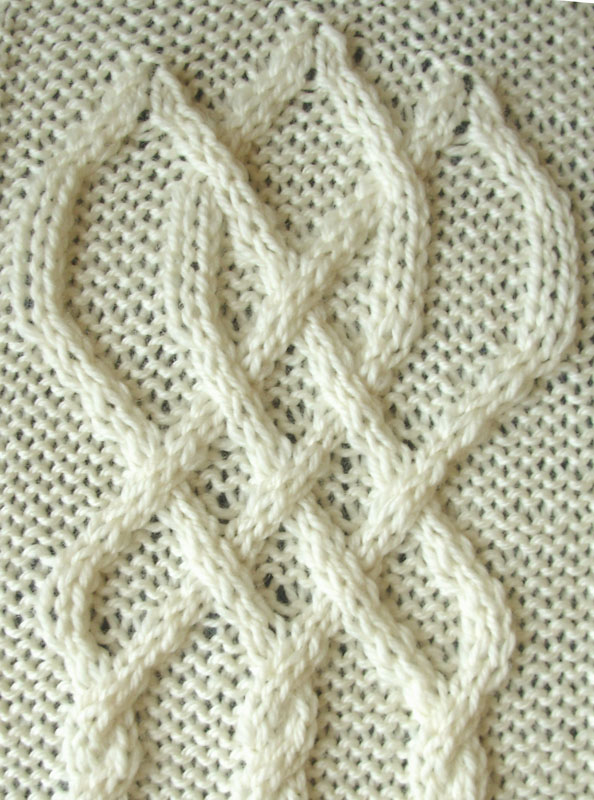
This knot was inspired by an image from the Book of Kells found on page 28 verso (the back side of the page), where it is part of a border in a portrait of St. Matthew. Here's my hand-drawn attempt at reproducing this knot.


I know I suck at drawing, but you get the idea. My reference book is The Book of Kells Selected Plates in Full Color edited by Blanche Cirker. So.... here's what I came up with. I used Wolle Roedel Soft Merino knitted on US 8 needles (5 mm) for this swatch.


I wanted a cable that could be a continuous cable or a stand-alone knot. Like I tend to do, I charted this with some set-up rows (rows O1-O8), a chart repeat (rows 1-36), and some finishing rows (F1-F6). If you want to knit what I have photographed above, knit rows O1-O8 from the chart, then knit rows 4-36, rows 1-36, then rows 1-24, finishing with rows F1-F6.
For this combination of a picked-up knot cable, you need to begin with 24 cast-on stitches. If you want to knot a long continuous cable without the stand-alone start, you need to begin with 36 cast-on stitches. If that is your preference, I'd recommend knitting 3 4-stitch, 4-row rwisted rope braids as charted in rows 31-34 3 times. This might take a bit of swatching. Play with it and have some fun. If you want only the stand-alone knot, knit rows O1-O8, rows 4-24, then finish with rows F1-F6. Here's the chart...


Now I omitted the dots from the stand-alone parts of the knot. I originally swatched with some bobbles but I didn't like them - I suck at knitting bobbles. If anyone want to reproduce the original knot exactly, play with bobbles and email me a link to the pictures!

Here's some gratuitous detail shots...


Happy knitting!
P.S. Don't forget to get the legend.


Sunday, January 20, 2008

From the depths of Ivanova's archives...

I posted a F.O. shot of some lace muffatees I designed about 2 years ago on Ravelry and someone requested the pattern! I sent it out to a free online knitting magazine but never heard back, so I am posting it here now, because it seems that at least one person out there is interested!

I also have nothing to post on current knitting because of a major project deadline in a month (eep!) and I've also been taking advantage of my new Mac Book Pro being a faster Matlab-Number-Crunching-Machine than the computational servers at work! I loooove my new Mac... and I also love not having to share CPU time with anybody else! So here it is... my lace muffatee pattern.

What do you do with a couple of hundred yards of lace weight fiber? Especially when most shawls reach the elbow, and don’t cover your arms? Knit some lace muffatees with a Victorian-inspired ruffle, and look positively enchanting! Only want wristwarmers? Work less pattern repeats!

Materials:
200 yards of any lace weight fiber that can be blocked.
The ones shown were made with 200 yards of handpaintedyarn.com lace pure wool, 850 yards per 100 g skein, color burgundy
¼ inch wide sewing elastic (optional)
US 5 ( 3.75 mm) needles
Stitch Markers
A tapestry or darning needle to weave in ends
Scissors

Additional notes: I made these from the leftovers from my Kiri shawl, because the handpaintedyarn.com skeins have such generous yardage. I really liked working with this yarn because it's reasonably soft and very elastic. Blocks like a dream!

Sizing:
One size fits most. The muffatees fit 6-6.25” wide wrists, 9-10.25” wide arms beneath elbow, and are 10” long including ruffle. Lace stretches! If you have smaller arms, consider getting some elastic.

Gauge:
Blocked conservatively: 24 sts. in lace pattern = 4”

Pattern Notes:

The lace stitch pattern is very easy to memorize. I suggest knitting from the chart because this four stitch four row pattern is so simple, the only part you really need to keep track of are the edges, where increases are incorporated into the stitch pattern. The decreases used are k2tog, or knit two together, skp, or slip one purlwise, knit one, pass slipped stitch over, and sk2p, or slip one purlwise, knit two together, pass slipped stitch over. On the ruffle, you will be making a yarn over on the purl or wrong side. To do this properly, hold your yarn as if you were going to purl the next stitch, wrap your yarn around the needle, then purl.

Instructions:

Cast on 38 stitches using an invisible cast on. Knit 2 rows.
Knit all even numbered pattern rows (not charted to save space).

Lace pattern (work the written instructions here or follow the chart):

Row 1: k1, k2tog, yo, place marker, *sk2p, yo, k1, yo,* repeat from * to * to last 3 stitches, place marker, skp, yo, k1.
Row 3: k1, k2tog, yo, place marker, *k1, yo, sk2p, yo,* repeat from * to * to last 3 stitches, place marker, skp, yo, k1.
Row 5: k1, yo, k2tog, yo, place marker, *sk2p, yo, k1, yo,* repeat from * to * to last 3 stitches, place marker, k1, yo, k2.
Row 7: k1, yo, sk2p, yo, place marker, *k1, yo, sk2p, yo,* repeat from * to * to last 4 stitches, place marker, k1, yo, skp, k1.
Row 9: k1, k2tog, yo, k1, yo, place marker, *sk2p, yo, k1, yo,* repeat from * to * to last 4 stitches, place marker, skp, yo, k1, yo, k1.
Row 11: k2, yo, sk2p, yo, place marker, *k1, yo, sk2p, yo,* repeat from * to * to last 4 stitches, place marker, k1, yo, sk2p, yo, k1.
Row 13: k1, yo, sk2p, yo, k1, yo, place marker, *sk2p, yo, k1, yo,* repeat from * to * to last 4 stitches, place marker, skp, yo, k1, yo, k2.
Row 15: k1, yo, k2tog, yo, sk2p, yo, place marker, *k1, yo, sk2p, yo,* repeat from * to * to last 5 stitches, place marker, k1, yo, sk2p, yo, k2.
Row 17: k2, yo, place marker, *sk2p, yo, k1, yo,* repeat from * to * to last 2 stitches, place marker, k1, yo, k1.
Row 19: k1, k2tog, yo, place marker, *k1, yo, sk2p, yo,* repeat from * to * to last 3 stitches, place marker, skp, yo, k1.
Row 21: k1, k2tog, yo, place marker, *sk2p, yo, k1, yo,* repeat from * to * to last 3 stitches, place marker, skp, yo, k1.
Row 23: k1, k2tog, yo, place marker, *k1, yo, sk2p, yo,* repeat from * to * to last 3 stitches, place marker, skp, yo, k1.
Row 25: k1, yo, k2tog, yo, place marker, *sk2p, yo, k1, yo,* repeat from * to * to last 3 stitches, place marker, k1, yo, k2.
Row 27: k1, yo, sk2p, yo, place marker, *k1, yo, sk2p, yo,* repeat from * to * to last 4 stitches, place marker, k1, yo, skp, k1.
Row 29: k1, k2tog, yo, k1, yo, place marker, *sk2p, yo, k1, yo,* repeat from * to * to last 4 stitches, place marker, skp, yo, k1, yo, k1.
Row 31: k2, yo, sk2p, yo, place marker, *k1, yo, sk2p, yo,* repeat from * to * to last 4 stitches, place marker, k1, yo, sk2p, yo, k1.
Row 33: k1, yo, sk2p, yo, k1, yo, place marker, *sk2p, yo, k1, yo,* repeat from * to * to last 5 stitches, place marker, skp, yo, k1, yo, k2.
Row 35: k1, yo, k2tog, yo, sk2p, yo, place marker, *k1, yo, sk2p, yo,* repeat from * to * to last 5 stitches, place marker, k1, yo, sk2p, yo, k2.
Row 37: k2, yo, place marker, *sk2p, yo, k1, yo,* repeat from * to * to last 2 stitches, place marker, k1 yo, k1.
Row 39: k1, k2tog, yo, place marker, *k1, yo, sk2p, yo,* repeat from * to * to last 3 stitches, place marker, skp, yo, k1.
Row 41: k1, yo, k2tog, yo, place marker, *sk2p, yo, k1, yo,* repeat from * to * to last 3 stitches, place marker, k1, yo, k2.
Row 43: k1, yo, skp, yo, place marker, *k1, yo, sk2p, yo,* repeat from * to * to last 4 stitches, place marker, k1, yo, skp, k1.
Row 45: k2tog, yo, k2tog, yo, place marker, *sk2p, yo, k1, yo,* repeat from * to * to last 4 stitches, place marker, skp, yo, k2.
Row 47: k1, yo, sk2p, yo, place marker, *k1, yo, sk2p, yo,* repeat from * to * to last 4 stitches, place marker, k1, yo, skp, k1.
Row 49: k1, k2tog, yo, k1, yo, place marker, *sk2p, yo, k1, yo,* repeat from * to * to last 4 stitches, place marker, skp, yo, k1, yo, k1.
Row 51: k2, yo, sk2p, yo, place marker, *k1, yo, sk2p, yo,* repeat from * to * to last 5 stitches, place marker, k1, yo, sk2p, yo, k1.
Row 53: k1, yo, sk2p, yo, k1, yo, place marker, *sk2p, yo, k1, yo,* repeat from * to * to last 5 stitches, place marker, skp, yo, k1, yo, k2.
Row 55: k1, yo, k2tog, yo, sk2p, yo, place marker, *k1, yo, sk2p, yo,* repeat from * to * to last 6 stitches, place marker, k1, yo, sk2p, yo, k2.
Row 57: k2, yo, place marker, *sk2p, yo, k1, yo,* repeat from * to * to last 2 stitches, place marker, k1, yo, k1.
Row 59: k1, k2tog, yo, place marker, *k1, yo, sk2p, yo,* repeat from * to * to last 3 stitches, place marker, skp, yo, k1.
Row 61: k1, k2tog, yo, place marker, *sk2p, yo, k1, yo,* repeat from * to * to last 3 stitches, place marker, skp, yo, k1.
Row 63: k1, k2tog, yo, place marker, *k1, yo, sk2p, yo,* repeat from * to * to last 3 stitches, place marker, skp, yo, k1.

When you have completed row 64, knit 5 rows in k2 p2 rib. Cast off in pattern.

Make ruffle (not charted):
On lower edge with RS facing, pick up 38 stitches. On the next row (ws) k1 p1 into each stitch except edge stitches which are purled (74 stitches total).

Row 1: k1, * k2, yo, skp*, repeat from * to * to * to last stitch, k1.
Row 2: p1, * p2, yo, p2tog*, repeat from * to * to * to last stitch, p1.

Repeat these rows 9 times then bind off loosely. Make another muffatee the same way.

Finishing:

When the knitting is done, block the muffatees before seaming them. Do not block the ruffle. To block, soak the muffatees for about 20 minutes before washing them, if you choose to wash them. Gently press out excess water without wringing them, place them in a clean towel, and roll the towel to remove more water. Stretch them to be about 1/2 an inch smaller than your arm measurements at the wrist and arm below elbow, and stretch to meet your arm’s length keeping side edges and top edge and wrist edge straight. Do not pull on the ruffle beyond stretching the wrist edge where you picked up stitches to make the ruffle. Seam up sides. If it is a little loose or you have small arms, sew in some elastic available at many fabric stores into the wrong side of the upper edge, below the elbow. If you use a dark color of yarn, you may want to use black elastic, I used white elastic in the example and it doesn’t show.

Enjoy!

Ivanova

Saturday, November 17, 2007

So much to knit, so little time!

I went to Berlin last weekend and finished up Klaralund just in time for the trip; good thing too because it was FREEZING! Snow and hail and rain all at the same time. Yuck! But I love going to Berlin, so a little bad weather won't slow me down too much. I just wish I'd packed smarter. Anyways here's the pics and details.
And for the modelled shot:
It looks saggy in this shot because I'm slouching. It really fits me quite well, and is very cosy and warm. I'm not a big fan of wearing pullovers, but I really like wearing this one.

Pattern: Klaralund from Noro - Cornelia Tuttle Hamilton Collection Book Number 2.

Yarn: Noro Kureyon 157 E, with balls swapped every second row except for the extended garter stitch pattern at the shoulders. I figured that part would look nicer if each flat bit plus ridge was a different color instead of striping within the pattern, so I swapped every 4 rows there (the pattern repeat is 4 rows).

Modifications: I added 1 inch of waist shaping on each side. I was also a bit hesitant about making the sweater because it tends to pull up at the neckline and look funny at the boob area. The last thing I want is to look like I have weird boobs. Check out the book's photo of this sweater on a fairly flat-chested young girl. Also google the pattern, you'll see many examples of this on other people with different figure types. My solution: I increased 1 inch on each side of the sleeve over the last 4 repeats of the extended garter stitch pattern. (The body is essentially a boob-tube and the sleeves are sewn into the top for shoulder coverage, giving the V-neck shaping, if you can't guess at the construction by the laying-on-the-bed photo). How did I come up with 1 inch each side? I put on the boob-tube and pinned it to my t-shirt at half-way over the boobs (this is where I figured the piece would lie from looking at many photos). Then I had my husband measure the length from back to front just over the shoulder (where there is not so much boob) and from half-way between my shoulder and spine (where there is more boob). With ease, I figured an inch would do the trick. I think it worked out pretty well, but each person should calculate this for themselves. Some people did not have this problem with this sweater, it could also depend on the broadness of one's shoulders.

Anyways, I'm very happy with the result! Yay! So what did I see in Berlin? Many shops, got my hair cut, many artsy cafes, and I went to an art gallery that was not so close to the city centre that has a large collection of pieces from 1400 to 1800 (or so, I lost the brochure). I was surprised at how well preserved the older pieces were, some of them managed to preserve the extremely bright colors of the paints. I mainly went to troll for costume ideas to augment my middle-ages dresses. There were very many religious paintings, but a few of relatively mundane situations. Here's the original photo I took of an inspirational piece from about 145o, roughly the late middle ages.
I know it's very blurry, but the lighting levels in art galleries are far from ideal for inexpert photographers and of course flash photography is forbidden. So do you see what I see? It's a capelet! This is what I came up with after some intensive photoshopping...
It's a textured capelet! I can make this... if you look closely it's a diamond and bobbles pattern, which I have in my harmony guide for aran knitting. And the edging? Hard to tell, but I think I could use seed stitch and get away with it. And I believe that there is a ribbon threaded though the edging and used as a fastener... I'll have to think about that because a worsted-weight capelet will be a bit heavy to be held shut by a ribbon-tie. I'd also like the capelet to be a bit longer than the one in the painting, but I'll have to see what I can get away with, with the 700-or so yards of gorgeous handspun blue aran weight wool yarn I bought in Berlin. Do I think the original garment in the painting was knitted? Before enhancement I thought the garment was made from a brocade fabric, but with enhancement I think it could have been knitted based on the shadows around the texture work. Who knows, I'm no expert. As long as it'll make it past the door-guy at the next festival, I'm happy. If only I had the CSI 'get-something-from-nothing' filter ;). I'll probably cast on after Christmas.

On the list of things to knit now: 1). The original design sweater which is being very naughty. I have to rip back many rows and rework the neckline. Boo! 2). Trud from Elsebeth Lavold Viking Knits Collection Volume 1 . Incentive: It's mostly reverse stockinette. If done as instructed (with seaming, yuck), it should be a reasonable fast knit once I get past the peplum. And I bought the yarn at the Easter Market, if I need more, I'll need to get it from the Market Yarn Lady who will be back for the Christmas Market. Disincentives: I'll need to do some serious math to make sure everything is in the right place. And I'll need to dig up my pre and post blocked swatch information. Still, I'm in the mood for it. I think I'll go do that now!

Ivanova

Saturday, October 27, 2007

Celtic Knot #6

Linked Rings With a Twist

Well folks, there is finally a new knot! These days I've been looking for inspiration, and increasing my Celtic Knot source library has helped. There are a lot of very beautiful knots out there, but they won't all look good on sweaters. I've also been hunting for good photos of Celtic Knot stone and metalwork for inspiration and came across a few good ones. I think I need a copy of the Book of Kells too, that would help! Anyone know where I can get one? Is there one?
Anyways, here's the knot... I coupled a linked-rings motif (probably identical to Lavold's from Viking patterns for Knitting) with a twisted-loop cable on the right.


This sample was knit from Wolle Rodel Soft Merino on US 8 (5 mm) needles. This was also done using Grumperina's method/tutorial of knitting cables without a cable needle. This takes a bit of practice to feel as natural as using a cable needle, but it's worth the effort. I'm tired of picking cable needles out of the couch cushions, the bottom of my purse, etc...!
This panel starts with 20 stitches, increases to 32 stitches (over the first 4 rows), then decreases back to 20 stitches in the last 2 rows. It's set up to be a 'true knot' with no beginning and no end, so I began with a hearts motif with a twisted loop to the side (rows O1-O16) which grows into the linked ring motif connected to the loops (rows 1-28) and finishes with a hearts motif with the twisted loop on the side (rows F1-F16). The center of the panel (main motif, rows 1-28) are meant to be repeated as many times as is desired, then finished off with the top of the knot. But the main motif would be nice on it's own too, it's just not a knot anymore, it's a braid.

Other modifications could include flipping this around and having the twisted loops on the left of the linked rings, or having twisted loops on both sides and eliminating the hearts (or pretzals [sic] ;) ). Excercise for the reader! This knot uses the legend from this project, so be sure to get it if you haven't already. I think that this would make a nice wide border panel, running along the long sides of an afghan or a cardigan. Here's the chart...


Ivanova

Monday, September 10, 2007

The Tara Stole pattern

Sorry for the delay, I've been running around a fair bit these days. Well, without further ado, here it is...

Materials:
2 Hanks (340 m or 370 yards) Hand Maiden 4 ply Silk Cashmere [Color A]
1 Cone ColourMart Cashmere 4/14 Double Twisted DK Weight (570.0 yards or 520 m) [Color B]
1 US7 (4mm) circular needle (for back and forth knitting, you can use straight needles if you prefer)

Substitutes:
370 yards of any DK weight variegated yarn and 570 yards (or more) of a solid DK weight yarn that goes with it. I recommend using a natural blockable fiber (not superwash), but again, this is up to you!
OR
940 yards of a solid colored DK weight yarn

I'm not sure how a variegated colorway would look in the small spider pattern, but I think that variegated yarns look great with wavy lace patterns. If you have 940 yards of a variegated DK weight yarn and want to use it, swatch chart B over a large number of stitches and see how you like it.

Gauge:
Not crucial. I aimed for a dense fabric where there are no yarn-overs , and the yarn-over holes were big enough for my liking (I can stick my pinky finger through them). I was aiming for a colder weather shawl and this fits the bill perfectly. If you are an extremely tight knitter (or a loose knitter) you may want to go up (or down) a needle size. If you don't want to throw caution to the wind and want to do a swatch, swatch 45 stitches of chart A because the spider pattern is quite open anyways.

Blocked dimensions: 75 inches long by 22 inches wide with a light blocking.

Note: Right side rows are NOT charted. For ALL right side rows, Knit 2, Purl to last 2 stitches, Knit 2. The 2 stitch wide garter stitch border will form a non-rolling edge.

Upper border: Madeira Cascade

Loosely cast on 105 stitches with color A. Knit 4 rows of garter stitch (knit each row). Begin chart A. You will be knitting the 12 side stitches, 4 repeats of the center 20 stitches (between the red lines on the chart) and the final 13 side stitches. I have typed the number of plain knitted stitches in between yarn overs or decreases in red, to make the chart easier to follow. Knit 4 repeats of Chart A.


Center Pattern: Alternating small and large beads
Switch to yarn B. Knit 4 side stitches from chart B, work 6 stitch pattern repeat 16 times, knit 5 side stitches from chart. Repeat chart B 40 times.

Note: How many times you repeat chart B depends on how much yarn you have. By weighing your ball (or cone) of yarn before and after one full repeat of chart B you can estimate how many repetitions you can get out of your yarn and knitting gauge. If you are working with one type of yarn, be sure to leave about 187 yards (170 m) for the lower border.

Lower Border: Inverted Madeira Cascade
I did something tricky here... I basically knit Chart A upside down (worked rows 19 to 1 instead of 1 to 19) hoping that I'd get a mirror image of the upper border. It didn't quite work out, as we can see by examining the pictures closely, but I like it anyways. If you don't like it, you can either knit chart A in the proper order and throw any attempt at symmetry out the window, or if you are a big fan of symmetry you can put your stitches on hold (or a separate needle), knit 4 rows in garter stitch with yarn A, knit chart A according to the instructions for the upper border, and graft the body of the stole to the lower border. I suck at grafting, so I cannot provide very good instructions for that step. You should probably put a lifeline between the main body pattern and the lower border if you are undecided.

Lifeline instructions: get a smooth piece of scrap yarn that is reasonably thin (or a thread) that is a bit over 2 times the width of the stole. Put yarn on needle and thread through each stitch on your needles (being sure to catch all the yarn-overs). Pull yarn through and knot. Continue knitting.

Begin chart C using yarn A. You will be knitting 12 side stitches, 4 repeats of the center 20 stitches (between the red lines on the chart) and the final 13 side stitches. Knit 4 repeats of Chart C. To finish, knit 4 rows of garter stitch. Cast off loosely. My preferred method is to start: knit 2. Slip to left hand needle, knit 2 together. To continue: knit one, slip both stitches to left hand needle, knit 2 together. Repeat until one stitch is left, pull yarn through.

And here's the legend.
Now I have presented this for web-viewing but not for printing. I recommend downloading the charts separately (JPEG format) and using your favorite photo editor to resize them and attempt to put them on one page. Then you can copy and paste the text from this web page to a text editor and print them to keep the instructions handy. I haven't quite figured out how to post a PDF document onto the blog yet!

Enjoy!
p.s. You can search for the tag 'Tara Stole' to find my previously published tip on how to do the SK2P decrease faster, because chart B requires doing it an awful lot!

Saturday, August 04, 2007

I present the latest FO....


Yes, it's a heap of lovely cashmery silky lace! Here's the full-body shot of my Tara stole.
It came in at about 75 inches long by 22 inches wide with a gentle blocking. One of the joys of working a lace pattern in big yarn with big needles is that you don't have to sweat the final dimensions so much! It's big! And it was a relatively quick knit too. The last rectangular shawl I made took me about 4 months to knit. This one took about 3 months, but I've been working on other stuff too. Now for the details:

Yarns: The variegated stuff is Hand Maiden 4 ply silk cashmere. I LOVE IT! It is the nicest softest least scratchy yarn I have ever used, and it has really nice drape too. Gorgeous colors. Thanks Delenn! The solid colored yarn is a DK weight cashmere from colourmart, purchased in a light blue color, then overdyed by me. I wanted a darker blue, and I ended up with a smoky purple, either way I like it. I was annoyed by how loosely the plies were spun, but once I got used to going a little slower, and checking the problem areas (sk2p decreases) it all went OK. Once washed the yarn softened up a lot, and has a very nice drape too. I have no issues wearing this against bare skin, unlike some alpaca yarns I have tried in the past, which still have some guard hairs in there which poke me in the neck! To make a long story short, the 500 or so yards was more than worth the 35 US dollars I paid for it. I will definitely consider this yarn for future luxury knits (without the luxury price! Since when can you get 100 % cashmere for 7 bucks/100 yard ball?).

Pattern: by me. I will post it once I have the time and dig myself out from the ever growing heap of things I need to do.

Now for the camera-held-in-a-mirror-shot:
and the stitch-detail shot:
Cheers,

Ivanova

Sunday, June 10, 2007

Dyeing just ain't my gift...

So I did the dye job, followed the instructions on the label and everything, and the yarn turned out purple. Purple! How on earth could a pale blue (not white as last week's image has led some of you to believe) yarn put in a darker blue dye end up friekin' purple? I just don't get it. But I don't hate it either, I think I ended up with quite a good contrasting color to go with the handpaint. Here it is...
all balled up. The dye job came out quite even, almost no mottledness is observable by the untrained eye. I think that I should have "primed" the yarn with vinegar if I wanted the color darker, but it wouldn't have ended up bluer. I tied up the hank with white superwash merino (scraps from the Celtic Knot Project swatches) and they sucked up the dye like crazy (as I expected from reading several handy web resources on hand dyeing yarn) but they were dark PURPLE. Not blue. Oh well... At least this turned out better than my first hand-dye experience which involved 880 yards of Knitpicks dye your own laceweight merino, Kool Aid, plastic bags,
some chopsticks and a turkey baster, a microwave oven, a huge mess my husband was very grumpy about, and a hank of very sorry looking felted up yarn that looked just plain ugly to my too-high-expectations-self. I swore I'd never do it again. How do some people get such fantastic results? Anyways I'm digressing. Here's a detail shot of the main body lace pattern.
Not bad, I think. It wasn't what I had expected, but I drastically lowered my expectations after the aforementioned bad experience, and I think it actually goes better then a random shade of blue would have. It's the same shade of purple as a short section of the hand dye. And the yarn softened up a fair bit in the washing process. It's a DK weight cashmere from colourmart.com
and the price was quite reasonable. I thought it was a bit coarse knitting with it before I ripped to do the dye job, but not scratchy, just coarse. Maybe that has to do with the tightness of the twist of the plies or something, though the yarn itself (composed of several plies, 4 I think) is somewhat loosely plied. I have to look at my knitting a fair bit to make sure I don't drop a ply, especially when doing the double decreases, like, every third stitch in this pattern. I still find it sortof coarse, but a bit less so. Don't get me wrong, it's way softer than a majority of the wools I knit with (except the superwash merino) and dosen't have long fibers that stick out like with Alpaca that tickle me (and my nose) when I knit with it. I guess I just expected something smoother and maybe fluffier. I have never knit with cashmere before, I thought it was too expensive. It's still pricier than most of the stuff I work with, but for a small luxury project (i.e. not a sweater), the price isn't bad.
I think it works...

Ivanova

Saturday, June 02, 2007

Phew! What a trip!

Last week, my husband and I decided to go to Berlin for the long weekend. What a trip! We had a blast, and some interesting weather...
first there was the torrential rain on the first day, Friday.
Then there was the hail on Saturday. In between the rain and hail, we wandered around the cute old streets of former East Berlin, ate at some nice restauraunts, including the best Mexican food I've had since leaving North America, and found a very nice yarn store (Loop) in a very cute neighborhood with a nice open air market where the vendors were selling all sorts of things from handmade baby shoes to candy. Mmmm. I succumbed to the tourist's need to buy something to commemorate the trip...
Dare I say it? It's YUMMY, so yummy. I saw it shining at me in Loop, and it was SO SOFT! I had to have it! I think it's a domestically produced handspun, no label. Another mystery wool... heh heh. I did some research on the internet, and I believe it's a 50/50 mulberry silk merino blend, the weight (100g), stated yardage (300m) and recommended needle size (3-4 mm) and color is very similar to a product I found at a 'natural crafts' site in Germany. Same price too, so there ya go. Now I know, yarn diet, but this is the only thing I bought for me ( I also got one gift for someone) and I'm supporting the domestic economy, so there. That's how I justify it to myself anyways. I think that it will become fetching. I already find it quite fetching in the skein. Heh heh bad joke. Anyways, we had very nice weather on Sunday, here's a shot of Neptune and his maidens.
See that? Blue skies... Now I really want to go back, and have one of the maidens model the Tara Stole when it's done, I got a fair bit done on the train.
The handpaint is Hand Maiden 4 ply Silk Cashmere, and I decided on an Old Spanish Lace Border. The body is being knit from a DK weight cashmere purchased on the net from the UK for a criminally low price because none of my stash yarns were the right weight or texture. I found the right stitch pattern, an alternating small and large bead pattern to go with the small beads in the Old Spanish Lace. Unfortunately, I don't like the way the colors look together, so I'll rip back, put the yarn into 50 g hanks, and dye it a darker shade of blue. Then it'll be PERFECT. I hope.

The hubby and I went to the zoo on Monday before taking the train back, and I ran around like a crazy person snapping photos of the fiber-bearing animals like this bactrian camel.
The fiber is literally falling off him! (Or is it her...?) There were large tufts of it all over the place. Now I leave you with this adorable sleeping baby bear who is not the star, but I think maybe he could be... so cute!

Ivanova