Showing posts with label Celtic Knot Project. Show all posts

Saturday, January 26, 2008

Celtic Knot #7

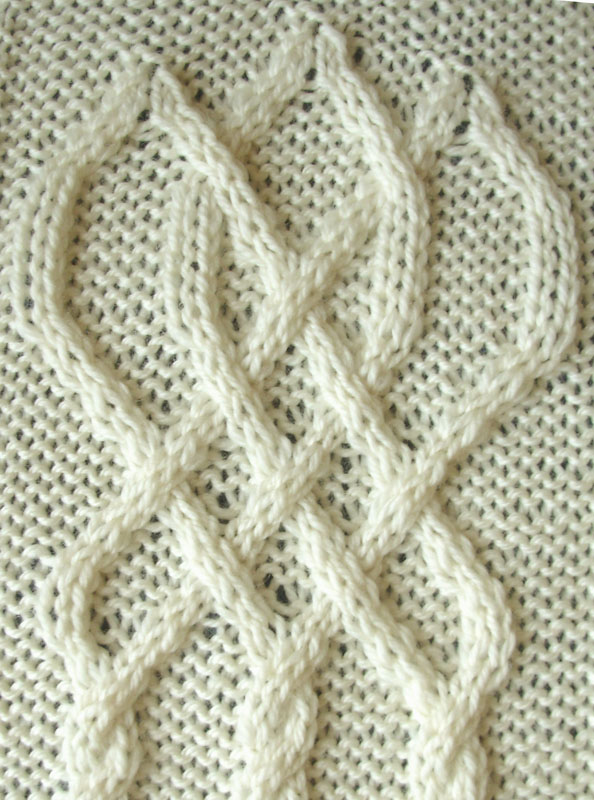
Intertwined Heart and Happiness Sign

This knot was inspired by an image from the Book of Kells found on page 28 verso (the back side of the page), where it is part of a border in a portrait of St. Matthew. Here's my hand-drawn attempt at reproducing this knot.


I know I suck at drawing, but you get the idea. My reference book is The Book of Kells Selected Plates in Full Color edited by Blanche Cirker. So.... here's what I came up with. I used Wolle Roedel Soft Merino knitted on US 8 needles (5 mm) for this swatch.


I wanted a cable that could be a continuous cable or a stand-alone knot. Like I tend to do, I charted this with some set-up rows (rows O1-O8), a chart repeat (rows 1-36), and some finishing rows (F1-F6). If you want to knit what I have photographed above, knit rows O1-O8 from the chart, then knit rows 4-36, rows 1-36, then rows 1-24, finishing with rows F1-F6.
For this combination of a picked-up knot cable, you need to begin with 24 cast-on stitches. If you want to knot a long continuous cable without the stand-alone start, you need to begin with 36 cast-on stitches. If that is your preference, I'd recommend knitting 3 4-stitch, 4-row rwisted rope braids as charted in rows 31-34 3 times. This might take a bit of swatching. Play with it and have some fun. If you want only the stand-alone knot, knit rows O1-O8, rows 4-24, then finish with rows F1-F6. Here's the chart...


Now I omitted the dots from the stand-alone parts of the knot. I originally swatched with some bobbles but I didn't like them - I suck at knitting bobbles. If anyone want to reproduce the original knot exactly, play with bobbles and email me a link to the pictures!

Here's some gratuitous detail shots...


Happy knitting!
P.S. Don't forget to get the legend.


Saturday, October 27, 2007

Celtic Knot #6

Linked Rings With a Twist

Well folks, there is finally a new knot! These days I've been looking for inspiration, and increasing my Celtic Knot source library has helped. There are a lot of very beautiful knots out there, but they won't all look good on sweaters. I've also been hunting for good photos of Celtic Knot stone and metalwork for inspiration and came across a few good ones. I think I need a copy of the Book of Kells too, that would help! Anyone know where I can get one? Is there one?
Anyways, here's the knot... I coupled a linked-rings motif (probably identical to Lavold's from Viking patterns for Knitting) with a twisted-loop cable on the right.


This sample was knit from Wolle Rodel Soft Merino on US 8 (5 mm) needles. This was also done using Grumperina's method/tutorial of knitting cables without a cable needle. This takes a bit of practice to feel as natural as using a cable needle, but it's worth the effort. I'm tired of picking cable needles out of the couch cushions, the bottom of my purse, etc...!
This panel starts with 20 stitches, increases to 32 stitches (over the first 4 rows), then decreases back to 20 stitches in the last 2 rows. It's set up to be a 'true knot' with no beginning and no end, so I began with a hearts motif with a twisted loop to the side (rows O1-O16) which grows into the linked ring motif connected to the loops (rows 1-28) and finishes with a hearts motif with the twisted loop on the side (rows F1-F16). The center of the panel (main motif, rows 1-28) are meant to be repeated as many times as is desired, then finished off with the top of the knot. But the main motif would be nice on it's own too, it's just not a knot anymore, it's a braid.

Other modifications could include flipping this around and having the twisted loops on the left of the linked rings, or having twisted loops on both sides and eliminating the hearts (or pretzals [sic] ;) ). Excercise for the reader! This knot uses the legend from this project, so be sure to get it if you haven't already. I think that this would make a nice wide border panel, running along the long sides of an afghan or a cardigan. Here's the chart...


Ivanova

Sunday, May 13, 2007

Celtic Knot Project Installment #5

Hearts on a Mat Connected by Braids

This one was modified from an illustration in Sheila Sturrock's Celtic Knotwork Handbook, panel 86 on page 87. I could have charted it as illustrated, but I wanted a continuous cable, not a stand-alone knot, so I extended the start and finish of the lowed and upper loops into twisted
cables. It would not be difficult to modify into a stand-alone panel.... heh heh, I'm leaving this as an excercise to the reader! Hint: it's super easy to visualize if you have Sturrock's book in front of you. Anyways, here are the photos.


These photos are of the same swatch, but there was sucky natural light due to the week-long overcast skies, so the top one was taken in the window with some non-natural light from the ceiling lamp, and the lower photo was taken with a flash. Either way, you get the idea. This sample was knit from, yeah you guessed it if you're a regular reader, Wolle Rodel Soft Merino.
This panel starts with 32 stitches, increases to 40 stitches, then decreases back to 32 in the last 2 rows. It is 30 rows long. Here's the chart:
A few notes on this one:
1. I used a couple of new symbols here than in previous installments - I needed to cross 2 knit stitches over 3 purl stitches in a few places to make space in between the backs of the hearts. These symbols are not in the legend, and I don't want to update it every time I use a new symbol, so instead I included them at the bottom of the chart. You do not need to re-download the legend if you already have it, but you do need it to interpret this chart if you don't already have it.
2. Knitting is always the best test of an abstract idea, like taking an illustration and turning it into something three-dimensional. Having charted and knitted it, I see something I would have done differently, and will change if I use this panel in a design. (Aside: you know I will!) If you don't want to wait, I will type it out here in words, and you will have to alter the chart yourself, unless you like it as presented. I would move the two left cable crossings from row 1 to row three. I would then eliminate rows 29 and 30 from the chart alltogether, making this a 28-row repeat panel.
3. I think this would look very nice if there were several twists in the braid before making the knot, and I think this is how I would use it, with at least 1 extra left twist in the braids connecting the knots, maybe more.

Cheers,

Ivanova

Sunday, April 29, 2007

Celtic Knot Project Installment #4

Hearts and Loops

I knitted up three separate panels containing hears and left and right facing loop knots in this swatch. The central panel was illustrated in Sheila Sturrock's Celtic Knotwork Handbook, and I made panels of only left facing and right facing loop knots to go with it. They would be nice for symmetry purposes, on the right and left sides of a garment, for example. The central panel would be nice as a stand-alone panel, or put all three together - it's up to you! The chart is below: The chart is below:


Notes on the charts:

-To knit the hearts with right facing loop knots (on the left of the swatch), start with the set-up rows a.k.a. the upoward facing hearts, rows O1-O18, knit rows 1-22 twice, and then knit the finish rows a.k.a. the downward facing hearts, rows F1-F16.
-To knit the hearts with left facing loop knots (on the right of the swatch), follow the instructions above, but use the other chart.
-To knit the hearts with alternate left and right facing loop knots, start with the set-up rows for the hearts (they are the same for both charts), knit rows 1-22 once of the left facing chart, then knit rows 1-22 once of the right facing chart, then finish with the finishing rows, they are identical in both charts.
Also note that you can knit rows 1-22 as many times as you like, and the set-up and finishing heats can be omitted if you prefer.

Ivanova

Sunday, April 15, 2007

Celtic Knot Project Installment #3

Right and Left Facing Hearts on a Wide Rib Panel

Here's the swatch.


I quite like this one, I think it would make nice panels on the sides of a sweater knitted in a fingering weight yarn so they're not so wide, or together as a center panel. On the left is the right facing heart panel, and on the right is the left facing heart panel. The right facing heart was charted from Sheila Sturrock's Celtic Knotwork Handbook, from a panel on page 28, chapter 3 panel number 2. To satisfy my deep-seated need for symmetry, I charted an opposite-facing panel as well. This sample was knitted in Wolle Roedel Soft Merino, and the charts are presented separately. Immediately below is the chart for the right facing heart panel,
and here is the chart for the left facing heart panel.


Refer to the legend link at the upper left (under the Celtic Knot Project sidebar item) to figure out what these symbols mean. Now for a few words on the charts:
1. These panels start as 18 stitches wide, grow to be 26 stitches wide with the increases on set up rows o1 and o3 and repeat rows 1 and 3, then narrow to 18 stitches with the decreases on repeat rows 19 and 20, and finishing rows F23 and F24.
2. Rows o1-04 are set up rows. Knit them once, continue through the pattern repeat rows 1-24 as many times as you like, but on the last repeat finish with rows F23 and F24 instead of 23 and 24.
3. The swatch above was made by placing the charts for the right and left facing heart panels side by side. I knit rows o1-o4 once, rows 1-24 once, rows 1-22 once, and rows F23 and F24 once.

Have fun swatching!

Ivanova

Sunday, April 08, 2007

The Celtic Knot Project installment #2

Two Hearts Facing Inwards
This panel was charted from Sheila Sturrock's Celtic Knotwork Handbook, from an illustrated variation of panel 4 from chapter 3, page 29. I have seen hearts connected on twisted cables before, like in the sleeve and side panels of Cromarty (see a lovely example here) from the Celtic Collection by Alice Starmore, but this one is unusual because the hearts face the other way and the cables swing out a bit before coming in again. And I think the increase technique I used is nicer because the heart-shaped knots are more angular, and dosen't pucker the fabric. Here's the swatch.


I only knitted one repeat, but you get the picture. The swatch was knitted from Wolle Roedel Soft Merino, an aran weight superwash merino yarn that is very soft and springy. Sorry, I think it's only available in Germany. Now here's the chart:

A few words are in order before you start knitting it up.
-Rows O1-O4 are set-up rows. Only knit them once, continue the chart as far as you desire, and when you are ready to finish the panel, instead of knitting rows 35 and 36, finish with rows F35 and F36.

-I had to put cable crossings across the no-stitch symbol on rows 3 and 31. I know it's a bit ugly, but it works the same as if those black squares were not on the chart at all. When you get to the black squares just keep on going. To be absolutely explicit, as an example, say you are starting row 3. Purl 8 stitches, slip 2 purl stitches to your cable needle and hold to the back, knit 2, purl 2 from the cable needle. Purl 4, slip 2 knit stitches to your cable needle and hold in front. Purl 2, then knit 2 from the cable needle. Purl 6. There, you're done row 3! Wasn't that easy?

-If you look closely at the swatch, you'll notice that the stitches immediately after the 4 stitch increases at the bottom (rows O1-O4) are crossed, and the stitches immediately before the decreases at the top (rows F35 and F36) are crossed. This is how the panel was illustrated in the book, and how I originally charted and knitted it, but I didn't really like it that way. Instead I charted it as a cable cross between repeats only. If you are willing to trust me on this, follow the chart as written. If not, knit rows 35 and 36 before row 1, and before rows F35 and F36, and you will end up with what I swatched.

Sunday, April 01, 2007

Nothing to report on the knitting front...

Sigh. I was away for a week at a conference in a very old cute medieval town, so I was very busy and had no time to knit, except on the train. Instead of working on my two ufos, I instead cast on for a new project that should use up a decent chunk of the stash, and I got a fair amount done on the train, partially because of severe delays (German trains run on time? Hah!) but not as much done if I had been knitting at home every evening. And it's top secret, so I won't mention it again, except to maybe complain about a particular technique or yarn/needle related problem. This yarn had been hanging like a boat anchor around my neck (as my husband would say), and I'm so gad to have finally envisioned the *right* project for it, seeing as I couldn't get gauge for the intended project, and the recipient wasn't very enthusiastic (yes, it was for the husband, before we got married). So instead I will show some pictures of interesting stone and metal work that I found, some of which may be charted and knitted up into cables as part of the celtic knot project.


I found this in the catacombs of the BIG OLD cathedral. Yup, genuine celtic knots. The region was first settled by Celts, then the Romans came, and apparently the cathedral was built over an old roman site which was most likely celtic befor the the Romans booted them out. Nobody I was with noticed these, because they were at the top of two pillars which were otherwise unremarkable. The circle with lines crossing through motif (at the very top of the pillar) is definitely knittable, I'll just have to check that Lavold hasn't already done it.


This was some grillwork around the back of the same cathedral, and it looks contemporary to my intrained eye, but it's still very pretty. While the little swirls may not be knittable as a texture pattern, I think I may be able to do something with the intertwined hearts background.

I know this is a terrible picture (stupid sun being in the wrong place!), but I like the two separate flower motifs as well as the asymmetry. I could probably poach the flower design on the left to incorporate into a design or something....


This guy isin't knittable at all, but I like him anyways. I found him on the roof of a very old monastery (Roman, or built on a previously Roman site), and the tour book says the drew their inspiration for the statues on the front gate from "earlier Northern traditions" whatever that means. I think he's grinning like a cheshire cat, kind of like the way I was when I discovered the Easter Market when I got home this weekend. The Easter Market is pretty much the same as the Christmas Markey, yarn booth and all. So I'm using my 'get out of jail free' card. Now Thrace thinks I already used it buying two balls of Soft Merino to swatch the Celtic Knot patterns, but I disagree. The Celtic Knot Project is a gift that gives twice, first to all of you who choose to download and use these patterns. Cream wool shows texture patterns the best, and no one will use it if the swatches look crappy. Second, the swatches will all be sewn together when there are enough of them, and given to a friend for a very special occasion, so it really is a gift that gives twice, and I read the rules, gift knitting is okay to buy new yarn for.

The Christmas Market/Easter Market wool vendor has natural undyed merino at an absolutely fantastic price, and I was pricing out natural wool at various UK and American sources, this stuff is a fantastic deal. And it supports local yarn producers. So less guilt. I got one hank already to swatch, so there!

Ivanova

Saturday, March 24, 2007

Free Cable Stitch Patterns featured at the Celtic Knot Project!

Note: if you just want to see charts and pictures, scroll down.

Okay, I know you're thinking 'What is the Celtic Knot project'? Well, after discussing at length
with Kara my frustration at the lack of celtic knot cable stitch pattern sources out there, the idea was born. The main sources of celtic knots I did find were Alice Starmore's work, dispersed among many of her books, notably Aran Knitting. Check out this photo of St. Brigid, for example. But this is a very hard to find book, as it is out of print, and is extraordinarily expensive if you do find a copy on eBay. Another great source of knotwork is Elsebeth Lavold's Viking Patterns for Knitting, which I adore and use heavily (as I'm sure some of you have noticed), but my use of her stitch patterns limits my ability to share the instructions for the finished pieces (like Ingrid, Eva, and the mittens I made last year for Christmas presents), as the Copyright Notice at the front of the book states "No part of this publication may be reproduced, stored in a retrieval system, or transmitted in any form or by any means, electronic, mechanical, photocopying, recording, or otherwise without prior permission of the publisher." This is very common copyright language which can be found on many stitch dictionaries, such as the Vogue Knitting Stitchionaries, etc... I find it odd, they are selling us instructions for stitches to encourage or spark our creativity, but we cannot share garment patterns using the charts or instructions, and I personally find it irritating to refer someone to book X, page Y instead of just providing a chart from a book. But I will not break copyright law either. Note that modifying something in a stitch dictionary makes the piece a derivative work, and is this safe, as are really old patterns, such as the "saxon braid" pattern found in numerous books, feather and fan lace, etc..., and no single author could ever claim to be the intellectual property holder of such works. I believe Barbara Walker's work falls into this category as well, because her work came from numerous (credited) sources, rooted in tradition. I think that's part of why so many designers draw from her treasuries directly, without making modifications.

So... what's a girl to do? Kara suggested that I make up my own cables based upon celtic art works, so I did just that. I chose an Attribution-NonCommercial-ShareAlike 3.0 Unported Creative Commons License. All that means is that the work that I have compiled is free to use, free to copy and share, and free to modify for non-commercial uses. Credit must be given to me, ivanovaknits, and if someone would like to use it for a commercial purpose, say to be incorporated in a garment pattern for sale, they just have to ask me first. I think this is much more flexible than what is offered by some stitch dictionaries. Now for the project details...

This is a derivative work of Elsebeth Lavold's Viking Patterns for Knitting. I use her techniques, as well as most of her notation. Without this book, I probably would not have been able to turn the pictures of celtic knotwork into cable panels. This work is not a substitute for Lavold's book, and I will not reproduce her work here. This is also a derivative work of Sheila
Sturrock's Celtic Knotwork Handbook. For the time being, all of the knotwork shown here will come from images in the book, or will be variations of those images. I will refer to the page number of the image I used in her book, but I will not scan images of the book, or draw these pictures, simply because I can't draw. This book teaches you how to draw celtic knots, and while I now know how to draw them, I still can't draw well.
So here's the first installment:

Small Hearts Connected By Ribs

I have charted and knitted panel 1 from chapter 3 of Sheila
Sturrock's Celtic Knotwork Handbook, page 27. It is a panel which consists of 12 cast-on stitches, which grows to 20 using directional increases, and then is reduced to 12 on the final row. While I have included instructions for making left-leaning and right-leaning increases that make sense to me, if you're confused, look it up in a techniques book, or refer to Viking Patterns for knitting, where Lavold includes pictures of how to make these increases. I had done them before reading her book, to make assymetrical thumb gussets on a set of mittens.
The pictures of the swatch:


These samples were knit out of Wolle Roedel's Soft Merino, a very soft and elastic superwash worsted weight merino wool on US 8 (5 mm) needles.
Here's the chart in jpg format, save it to your own computer, and fiddle with the sizing for ease of printing and reading.

And the legend... I intend to chart and swatch several knots, and they will all use this legend, so if you're interested, you might as well print out a copy and keep it with all the charts.


Happy cabling,

Ivanova