Showing posts with label lace. Show all posts

Tuesday, April 28, 2009

When life kicks your ass, knit socks!

I finished another couple of shawls recently and I have a sweater languishing in my project bag, but I can't seem to focus on anything bigger than a sock at the moment.

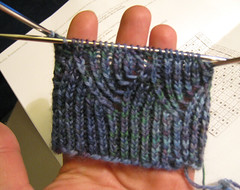
pomatomus beginning

Forest Canopy (ravelry link) and the Fountain Pen shawl (ravelry link) were very quick knits.

Fountain Pen got debuted at a friend's wedding a couple of weeks ago. If I can find a photo of it in action, I'll post it. Oh yes, and Handmaiden Mini Maiden is like yarn crack. I'm definitely going to use it again.

fountain pen

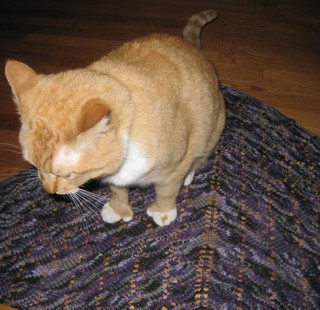
Here's Ricky inspecting Forest Canopy.

forest canopy

I knit this out of Lorna's Laces Shepherd worsted, which makes it a warm and sturdy, yet soft wrap for my chilly office. Also, it's cold out again.

Sunday, March 22, 2009

Wing 'o the Moth

New projects are more fun than repairing old ones. I just finished a shawl that I actually get to keep this past week.


This was a fun and easy knit, except for the bits where I didn't pay enough attention to the stitch pattern in the body of the shawl. I also added beads to the twin leaf border - not many, but enough to add a bit of sparkle (details on the ravelry project page). The yarn is a bit delicate (it looks really fragile in places), so I'm keeping the leftovers in case of emergency repair work. We'll see how this holds up over time.

Friday, January 30, 2009

Sweater surgery preliminaries

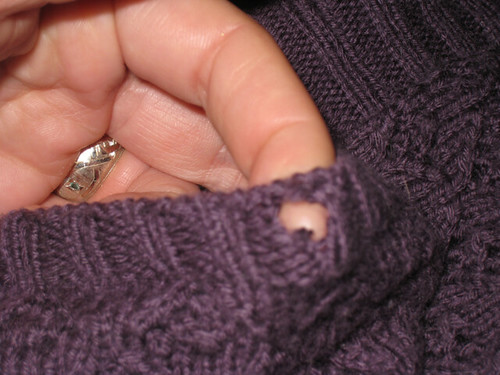
Arisaig gets a lot of wear, and usually that's a good thing. Unfortunately somewhere between Salt Lake City and Boston during a business trip last week, I noticed a hole in the cuff.


After getting really pissed, I realized that there's an easy fix. The sleeves are too long on the sweater, so I decided to rip back to a better length and knit back down.


I used circulars as a lifeline through the stitches in the row where I want the lace pattern to begin. I'll post updates as the surgery progresses.

Thursday, May 29, 2008

Still here

Still here, still knitting.


That's a Queen Anne's lace shawl I'm knitting on the train from Munich to Rothenburg ob der Tauber (cute town, very touristy).

I'll post more once I get home from vacation. The Blogger interface is a nightmare on my internet tablet.

Sunday, January 20, 2008

From the depths of Ivanova's archives...

I posted a F.O. shot of some lace muffatees I designed about 2 years ago on Ravelry and someone requested the pattern! I sent it out to a free online knitting magazine but never heard back, so I am posting it here now, because it seems that at least one person out there is interested!

I also have nothing to post on current knitting because of a major project deadline in a month (eep!) and I've also been taking advantage of my new Mac Book Pro being a faster Matlab-Number-Crunching-Machine than the computational servers at work! I loooove my new Mac... and I also love not having to share CPU time with anybody else! So here it is... my lace muffatee pattern.

What do you do with a couple of hundred yards of lace weight fiber? Especially when most shawls reach the elbow, and don’t cover your arms? Knit some lace muffatees with a Victorian-inspired ruffle, and look positively enchanting! Only want wristwarmers? Work less pattern repeats!

Materials:
200 yards of any lace weight fiber that can be blocked.
The ones shown were made with 200 yards of handpaintedyarn.com lace pure wool, 850 yards per 100 g skein, color burgundy
¼ inch wide sewing elastic (optional)
US 5 ( 3.75 mm) needles
Stitch Markers
A tapestry or darning needle to weave in ends
Scissors

Additional notes: I made these from the leftovers from my Kiri shawl, because the handpaintedyarn.com skeins have such generous yardage. I really liked working with this yarn because it's reasonably soft and very elastic. Blocks like a dream!

Sizing:
One size fits most. The muffatees fit 6-6.25” wide wrists, 9-10.25” wide arms beneath elbow, and are 10” long including ruffle. Lace stretches! If you have smaller arms, consider getting some elastic.

Gauge:
Blocked conservatively: 24 sts. in lace pattern = 4”

Pattern Notes:

The lace stitch pattern is very easy to memorize. I suggest knitting from the chart because this four stitch four row pattern is so simple, the only part you really need to keep track of are the edges, where increases are incorporated into the stitch pattern. The decreases used are k2tog, or knit two together, skp, or slip one purlwise, knit one, pass slipped stitch over, and sk2p, or slip one purlwise, knit two together, pass slipped stitch over. On the ruffle, you will be making a yarn over on the purl or wrong side. To do this properly, hold your yarn as if you were going to purl the next stitch, wrap your yarn around the needle, then purl.

Instructions:

Cast on 38 stitches using an invisible cast on. Knit 2 rows.
Knit all even numbered pattern rows (not charted to save space).

Lace pattern (work the written instructions here or follow the chart):

Row 1: k1, k2tog, yo, place marker, *sk2p, yo, k1, yo,* repeat from * to * to last 3 stitches, place marker, skp, yo, k1.
Row 3: k1, k2tog, yo, place marker, *k1, yo, sk2p, yo,* repeat from * to * to last 3 stitches, place marker, skp, yo, k1.
Row 5: k1, yo, k2tog, yo, place marker, *sk2p, yo, k1, yo,* repeat from * to * to last 3 stitches, place marker, k1, yo, k2.
Row 7: k1, yo, sk2p, yo, place marker, *k1, yo, sk2p, yo,* repeat from * to * to last 4 stitches, place marker, k1, yo, skp, k1.
Row 9: k1, k2tog, yo, k1, yo, place marker, *sk2p, yo, k1, yo,* repeat from * to * to last 4 stitches, place marker, skp, yo, k1, yo, k1.
Row 11: k2, yo, sk2p, yo, place marker, *k1, yo, sk2p, yo,* repeat from * to * to last 4 stitches, place marker, k1, yo, sk2p, yo, k1.
Row 13: k1, yo, sk2p, yo, k1, yo, place marker, *sk2p, yo, k1, yo,* repeat from * to * to last 4 stitches, place marker, skp, yo, k1, yo, k2.
Row 15: k1, yo, k2tog, yo, sk2p, yo, place marker, *k1, yo, sk2p, yo,* repeat from * to * to last 5 stitches, place marker, k1, yo, sk2p, yo, k2.
Row 17: k2, yo, place marker, *sk2p, yo, k1, yo,* repeat from * to * to last 2 stitches, place marker, k1, yo, k1.
Row 19: k1, k2tog, yo, place marker, *k1, yo, sk2p, yo,* repeat from * to * to last 3 stitches, place marker, skp, yo, k1.
Row 21: k1, k2tog, yo, place marker, *sk2p, yo, k1, yo,* repeat from * to * to last 3 stitches, place marker, skp, yo, k1.
Row 23: k1, k2tog, yo, place marker, *k1, yo, sk2p, yo,* repeat from * to * to last 3 stitches, place marker, skp, yo, k1.
Row 25: k1, yo, k2tog, yo, place marker, *sk2p, yo, k1, yo,* repeat from * to * to last 3 stitches, place marker, k1, yo, k2.
Row 27: k1, yo, sk2p, yo, place marker, *k1, yo, sk2p, yo,* repeat from * to * to last 4 stitches, place marker, k1, yo, skp, k1.
Row 29: k1, k2tog, yo, k1, yo, place marker, *sk2p, yo, k1, yo,* repeat from * to * to last 4 stitches, place marker, skp, yo, k1, yo, k1.
Row 31: k2, yo, sk2p, yo, place marker, *k1, yo, sk2p, yo,* repeat from * to * to last 4 stitches, place marker, k1, yo, sk2p, yo, k1.
Row 33: k1, yo, sk2p, yo, k1, yo, place marker, *sk2p, yo, k1, yo,* repeat from * to * to last 5 stitches, place marker, skp, yo, k1, yo, k2.
Row 35: k1, yo, k2tog, yo, sk2p, yo, place marker, *k1, yo, sk2p, yo,* repeat from * to * to last 5 stitches, place marker, k1, yo, sk2p, yo, k2.
Row 37: k2, yo, place marker, *sk2p, yo, k1, yo,* repeat from * to * to last 2 stitches, place marker, k1 yo, k1.
Row 39: k1, k2tog, yo, place marker, *k1, yo, sk2p, yo,* repeat from * to * to last 3 stitches, place marker, skp, yo, k1.
Row 41: k1, yo, k2tog, yo, place marker, *sk2p, yo, k1, yo,* repeat from * to * to last 3 stitches, place marker, k1, yo, k2.
Row 43: k1, yo, skp, yo, place marker, *k1, yo, sk2p, yo,* repeat from * to * to last 4 stitches, place marker, k1, yo, skp, k1.
Row 45: k2tog, yo, k2tog, yo, place marker, *sk2p, yo, k1, yo,* repeat from * to * to last 4 stitches, place marker, skp, yo, k2.
Row 47: k1, yo, sk2p, yo, place marker, *k1, yo, sk2p, yo,* repeat from * to * to last 4 stitches, place marker, k1, yo, skp, k1.
Row 49: k1, k2tog, yo, k1, yo, place marker, *sk2p, yo, k1, yo,* repeat from * to * to last 4 stitches, place marker, skp, yo, k1, yo, k1.
Row 51: k2, yo, sk2p, yo, place marker, *k1, yo, sk2p, yo,* repeat from * to * to last 5 stitches, place marker, k1, yo, sk2p, yo, k1.
Row 53: k1, yo, sk2p, yo, k1, yo, place marker, *sk2p, yo, k1, yo,* repeat from * to * to last 5 stitches, place marker, skp, yo, k1, yo, k2.
Row 55: k1, yo, k2tog, yo, sk2p, yo, place marker, *k1, yo, sk2p, yo,* repeat from * to * to last 6 stitches, place marker, k1, yo, sk2p, yo, k2.
Row 57: k2, yo, place marker, *sk2p, yo, k1, yo,* repeat from * to * to last 2 stitches, place marker, k1, yo, k1.
Row 59: k1, k2tog, yo, place marker, *k1, yo, sk2p, yo,* repeat from * to * to last 3 stitches, place marker, skp, yo, k1.
Row 61: k1, k2tog, yo, place marker, *sk2p, yo, k1, yo,* repeat from * to * to last 3 stitches, place marker, skp, yo, k1.
Row 63: k1, k2tog, yo, place marker, *k1, yo, sk2p, yo,* repeat from * to * to last 3 stitches, place marker, skp, yo, k1.

When you have completed row 64, knit 5 rows in k2 p2 rib. Cast off in pattern.

Make ruffle (not charted):
On lower edge with RS facing, pick up 38 stitches. On the next row (ws) k1 p1 into each stitch except edge stitches which are purled (74 stitches total).

Row 1: k1, * k2, yo, skp*, repeat from * to * to * to last stitch, k1.
Row 2: p1, * p2, yo, p2tog*, repeat from * to * to * to last stitch, p1.

Repeat these rows 9 times then bind off loosely. Make another muffatee the same way.

Finishing:

When the knitting is done, block the muffatees before seaming them. Do not block the ruffle. To block, soak the muffatees for about 20 minutes before washing them, if you choose to wash them. Gently press out excess water without wringing them, place them in a clean towel, and roll the towel to remove more water. Stretch them to be about 1/2 an inch smaller than your arm measurements at the wrist and arm below elbow, and stretch to meet your arm’s length keeping side edges and top edge and wrist edge straight. Do not pull on the ruffle beyond stretching the wrist edge where you picked up stitches to make the ruffle. Seam up sides. If it is a little loose or you have small arms, sew in some elastic available at many fabric stores into the wrong side of the upper edge, below the elbow. If you use a dark color of yarn, you may want to use black elastic, I used white elastic in the example and it doesn’t show.

Enjoy!

Ivanova
Monday, September 10, 2007

Arisaig

Finally.

After a year and 4 months, it's done.


The speed of execution is not a reflection of the pattern's quality; I think it turned out well once I started working on it at home rather than using it as a travel project.

Pattern

Arisaig by Ysolda Teague, in medium.

Yarn

Rowan Cashsoft 4 ply in Loganberry (MC) and Dale Baby Ull (CC) both from the Black Sheep Wool Co. Both yarns were not too difficult to work with: I found the Baby Ull somewhat splitty if I wasn't paying attention. It also got a bit of a halo after hand washing. Although the Cashsoft does pill a bit and I had to shave the sweater after blocking, it held up reasonably well after frogging. I found that the sweater needed aggressive blocking to open up the lace. I'm not sure if that's because of the Cashsoft or the lace pattern.

Mods

Very few: I knit the sleeves in the round at the same time because I had trouble getting a consistent gauge. I also added about 5 rows of stockinette to each shoulder to make the armsceye fit the sleeve cap better, then joined them using the three needle bind-off. Finally, I picked up and knit the ribbed tie stitches rather than sew it around the neckline. The one thing I would change: if I knit a sweater like this again, I would make it a little longer.


I started Arwen and a vest for C's uncle late last week. While some progress was made, the knitting will slow down for the rest of the month while I prepare for the Moab century (no Big Nasty this year due to road and bridge repair work). I'll be doing the 70 mile option, which should be hard enough.

The Tara Stole pattern

Sorry for the delay, I've been running around a fair bit these days. Well, without further ado, here it is...

Materials:
2 Hanks (340 m or 370 yards) Hand Maiden 4 ply Silk Cashmere [Color A]
1 Cone ColourMart Cashmere 4/14 Double Twisted DK Weight (570.0 yards or 520 m) [Color B]
1 US7 (4mm) circular needle (for back and forth knitting, you can use straight needles if you prefer)

Substitutes:
370 yards of any DK weight variegated yarn and 570 yards (or more) of a solid DK weight yarn that goes with it. I recommend using a natural blockable fiber (not superwash), but again, this is up to you!
OR
940 yards of a solid colored DK weight yarn

I'm not sure how a variegated colorway would look in the small spider pattern, but I think that variegated yarns look great with wavy lace patterns. If you have 940 yards of a variegated DK weight yarn and want to use it, swatch chart B over a large number of stitches and see how you like it.

Gauge:
Not crucial. I aimed for a dense fabric where there are no yarn-overs , and the yarn-over holes were big enough for my liking (I can stick my pinky finger through them). I was aiming for a colder weather shawl and this fits the bill perfectly. If you are an extremely tight knitter (or a loose knitter) you may want to go up (or down) a needle size. If you don't want to throw caution to the wind and want to do a swatch, swatch 45 stitches of chart A because the spider pattern is quite open anyways.

Blocked dimensions: 75 inches long by 22 inches wide with a light blocking.

Note: Right side rows are NOT charted. For ALL right side rows, Knit 2, Purl to last 2 stitches, Knit 2. The 2 stitch wide garter stitch border will form a non-rolling edge.

Upper border: Madeira Cascade

Loosely cast on 105 stitches with color A. Knit 4 rows of garter stitch (knit each row). Begin chart A. You will be knitting the 12 side stitches, 4 repeats of the center 20 stitches (between the red lines on the chart) and the final 13 side stitches. I have typed the number of plain knitted stitches in between yarn overs or decreases in red, to make the chart easier to follow. Knit 4 repeats of Chart A.


Center Pattern: Alternating small and large beads
Switch to yarn B. Knit 4 side stitches from chart B, work 6 stitch pattern repeat 16 times, knit 5 side stitches from chart. Repeat chart B 40 times.

Note: How many times you repeat chart B depends on how much yarn you have. By weighing your ball (or cone) of yarn before and after one full repeat of chart B you can estimate how many repetitions you can get out of your yarn and knitting gauge. If you are working with one type of yarn, be sure to leave about 187 yards (170 m) for the lower border.

Lower Border: Inverted Madeira Cascade
I did something tricky here... I basically knit Chart A upside down (worked rows 19 to 1 instead of 1 to 19) hoping that I'd get a mirror image of the upper border. It didn't quite work out, as we can see by examining the pictures closely, but I like it anyways. If you don't like it, you can either knit chart A in the proper order and throw any attempt at symmetry out the window, or if you are a big fan of symmetry you can put your stitches on hold (or a separate needle), knit 4 rows in garter stitch with yarn A, knit chart A according to the instructions for the upper border, and graft the body of the stole to the lower border. I suck at grafting, so I cannot provide very good instructions for that step. You should probably put a lifeline between the main body pattern and the lower border if you are undecided.

Lifeline instructions: get a smooth piece of scrap yarn that is reasonably thin (or a thread) that is a bit over 2 times the width of the stole. Put yarn on needle and thread through each stitch on your needles (being sure to catch all the yarn-overs). Pull yarn through and knot. Continue knitting.

Begin chart C using yarn A. You will be knitting 12 side stitches, 4 repeats of the center 20 stitches (between the red lines on the chart) and the final 13 side stitches. Knit 4 repeats of Chart C. To finish, knit 4 rows of garter stitch. Cast off loosely. My preferred method is to start: knit 2. Slip to left hand needle, knit 2 together. To continue: knit one, slip both stitches to left hand needle, knit 2 together. Repeat until one stitch is left, pull yarn through.

And here's the legend.
Now I have presented this for web-viewing but not for printing. I recommend downloading the charts separately (JPEG format) and using your favorite photo editor to resize them and attempt to put them on one page. Then you can copy and paste the text from this web page to a text editor and print them to keep the instructions handy. I haven't quite figured out how to post a PDF document onto the blog yet!

Enjoy!
p.s. You can search for the tag 'Tara Stole' to find my previously published tip on how to do the SK2P decrease faster, because chart B requires doing it an awful lot!

Saturday, August 04, 2007

I present the latest FO....


Yes, it's a heap of lovely cashmery silky lace! Here's the full-body shot of my Tara stole.
It came in at about 75 inches long by 22 inches wide with a gentle blocking. One of the joys of working a lace pattern in big yarn with big needles is that you don't have to sweat the final dimensions so much! It's big! And it was a relatively quick knit too. The last rectangular shawl I made took me about 4 months to knit. This one took about 3 months, but I've been working on other stuff too. Now for the details:

Yarns: The variegated stuff is Hand Maiden 4 ply silk cashmere. I LOVE IT! It is the nicest softest least scratchy yarn I have ever used, and it has really nice drape too. Gorgeous colors. Thanks Delenn! The solid colored yarn is a DK weight cashmere from colourmart, purchased in a light blue color, then overdyed by me. I wanted a darker blue, and I ended up with a smoky purple, either way I like it. I was annoyed by how loosely the plies were spun, but once I got used to going a little slower, and checking the problem areas (sk2p decreases) it all went OK. Once washed the yarn softened up a lot, and has a very nice drape too. I have no issues wearing this against bare skin, unlike some alpaca yarns I have tried in the past, which still have some guard hairs in there which poke me in the neck! To make a long story short, the 500 or so yards was more than worth the 35 US dollars I paid for it. I will definitely consider this yarn for future luxury knits (without the luxury price! Since when can you get 100 % cashmere for 7 bucks/100 yard ball?).

Pattern: by me. I will post it once I have the time and dig myself out from the ever growing heap of things I need to do.

Now for the camera-held-in-a-mirror-shot:
and the stitch-detail shot:
Cheers,

Ivanova

Sunday, July 01, 2007

So I promised a tutorial

on how to do the sk2p (slip one, knit two together, pass slipped stitch over) decrease faster, in one smooth motion. Well, here it is, instead of pictures of current knitting. This is partially because I've been concentrating on top-secret gift knitting, so no blogging about it, and also because the progress on Tara is reallly slow, and it looks exactly the same as my previous posts, it's just a bit longer. In other gift knitting news, I found out another friend is pregnant, so I'll be making 2 Baby Surprise Jackets. These adorable baby garments have been popping up like crazy on the internet (check out brooklyntweed's here) so I have to make it. The first recipient knows she will be getting one, and the other dosen't read this blog (I think!). So this way both recipients will still be surprised because they won't know which one they're getting! Hah!

Well, here we go with the tutorial, demonstrated on the Tara stole. I will start with a few words. First, I have noticed that very few patterns tell you if you should slip the stitch knitwise or purlwise. So if there is nothing specified, do it this way if you have a need for speed. Or you could try it both ways and block your swatches to see if there is really any difference. These instructions apply to slipping the stitch purlwise, not knitwise. The time saving step can also be applied to the left-leaning decrease skp (slip one, knit one, pass slipped stitch over) without much difficulty. I figured this out because the sk2p was really driving me crazy and slowing me down. So here we go...
Step 1: Here I am, starting with the yarn forward to make a yarn-over (yo). If you don't want a yo, start with the yarn in the back. So first you pass the left needle purlwise through the first stitch on the right hand needle, which I will have highlighted in yellow for all these pictures. Also note that my right hand (yarn feeding hand) is taking the pictures, so you should pretend that it's actually feeding the yarn instead of my left index finger as shown.
Step 2: with the slipped stitch nestled on both needles, manoever it slightly to the left and stab your right hand needle through the next two stitches. Hold your yarn like you are going to knit those two stitches.
Step 3: Wrap yarn around tip of right hand needle.
Step 4: Scoop loop through. Slide the 3 stitches off the needle. Really, at this point the slipped stitch will just fall around the 2 just knitted together. Now I'm using a loosely plied yarn so I like to give the resulting stitch a tug to see if I missed a ply, because the scooping process can tend to miss a ply every now and then. If you are using a sigle ply yarn this is a non-issue and you are off to the races!
Here's the result. Now you may be concerned that slipping purlwise will look different than slipping knitwise. Here's the unblocked comparison...
It's not noticeably different, the twist makes the slipped stitch sit in a different way, but it's really not noticeable to the casual observer. I'll take more shots when Tara's done and blocked.

Ivanova

Sunday, June 17, 2007

Knitting progress?

This pretty much illustrates it! I went on a nice little trip to Hannover on a very cheap group ticket, with a knitter/crocheter colleague and a visiting scientist from our research group. I found this cool statue outside the city hall. I have actually made significant progress on a gift project so I can't blog it. Pfft! The old town part of Hannover is very pretty, and we went a bit out of the way to look up a yarn shop.
Me in a yarn shop is like uncaging the beast, or in this case, releasing it from the column.
I came away with a little giftie for Delenn (sorry, no pics, you'll just have to wait till I send it in the mail) and a little something to swatch for a future project, and also knit up into a Christmas present I think. Unless I like it too much, and then I'll just keep it.
It's tweedy, and it's red... it's Garnstudio Silke-Tweed, purchased for about 1/2 the price of the average North-American retailer, which would make it feasible for a large project, like this one. I also saw lots of old buildings, narrow winding streets, beautifully manicured ponds,
and LOTS of ducks. They were easier to photograph than my town's ducks, probably because they're more used to people feeding them.
This guy let me get real close and he didn't even twitch a feather!

Now for the knitting progress...
Tara's coming along, I think I've cleared about 2 feet by now. However, knitting all those SK2P decreases was really driving me crazy, they're everywhere, and it really slows me down to slip a stitch then pass it over the two knitted together. I came up with a better way, to do it all in one motion, and I'll post about that at some future date, when I can get my DH to photograph my hands while I'm doing it, without getting all cranky about it. Here's a close-up shot of my "new way" of doing the decreases
Not bad, huh?

Ivanova

Sunday, June 10, 2007

Dyeing just ain't my gift...

So I did the dye job, followed the instructions on the label and everything, and the yarn turned out purple. Purple! How on earth could a pale blue (not white as last week's image has led some of you to believe) yarn put in a darker blue dye end up friekin' purple? I just don't get it. But I don't hate it either, I think I ended up with quite a good contrasting color to go with the handpaint. Here it is...
all balled up. The dye job came out quite even, almost no mottledness is observable by the untrained eye. I think that I should have "primed" the yarn with vinegar if I wanted the color darker, but it wouldn't have ended up bluer. I tied up the hank with white superwash merino (scraps from the Celtic Knot Project swatches) and they sucked up the dye like crazy (as I expected from reading several handy web resources on hand dyeing yarn) but they were dark PURPLE. Not blue. Oh well... At least this turned out better than my first hand-dye experience which involved 880 yards of Knitpicks dye your own laceweight merino, Kool Aid, plastic bags,
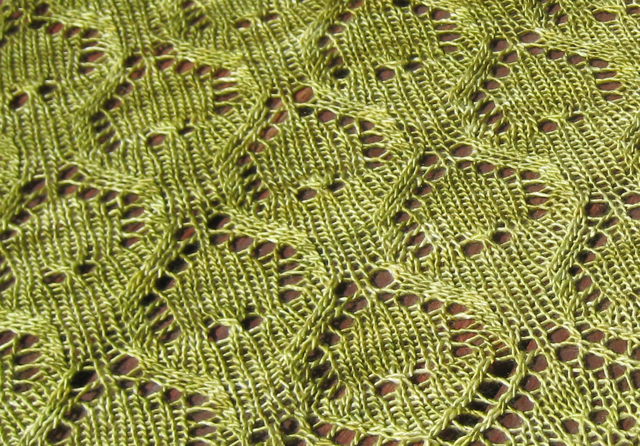
some chopsticks and a turkey baster, a microwave oven, a huge mess my husband was very grumpy about, and a hank of very sorry looking felted up yarn that looked just plain ugly to my too-high-expectations-self. I swore I'd never do it again. How do some people get such fantastic results? Anyways I'm digressing. Here's a detail shot of the main body lace pattern.
Not bad, I think. It wasn't what I had expected, but I drastically lowered my expectations after the aforementioned bad experience, and I think it actually goes better then a random shade of blue would have. It's the same shade of purple as a short section of the hand dye. And the yarn softened up a fair bit in the washing process. It's a DK weight cashmere from colourmart.com
and the price was quite reasonable. I thought it was a bit coarse knitting with it before I ripped to do the dye job, but not scratchy, just coarse. Maybe that has to do with the tightness of the twist of the plies or something, though the yarn itself (composed of several plies, 4 I think) is somewhat loosely plied. I have to look at my knitting a fair bit to make sure I don't drop a ply, especially when doing the double decreases, like, every third stitch in this pattern. I still find it sortof coarse, but a bit less so. Don't get me wrong, it's way softer than a majority of the wools I knit with (except the superwash merino) and dosen't have long fibers that stick out like with Alpaca that tickle me (and my nose) when I knit with it. I guess I just expected something smoother and maybe fluffier. I have never knit with cashmere before, I thought it was too expensive. It's still pricier than most of the stuff I work with, but for a small luxury project (i.e. not a sweater), the price isn't bad.
I think it works...

Ivanova

Saturday, June 02, 2007

Phew! What a trip!

Last week, my husband and I decided to go to Berlin for the long weekend. What a trip! We had a blast, and some interesting weather...
first there was the torrential rain on the first day, Friday.
Then there was the hail on Saturday. In between the rain and hail, we wandered around the cute old streets of former East Berlin, ate at some nice restauraunts, including the best Mexican food I've had since leaving North America, and found a very nice yarn store (Loop) in a very cute neighborhood with a nice open air market where the vendors were selling all sorts of things from handmade baby shoes to candy. Mmmm. I succumbed to the tourist's need to buy something to commemorate the trip...
Dare I say it? It's YUMMY, so yummy. I saw it shining at me in Loop, and it was SO SOFT! I had to have it! I think it's a domestically produced handspun, no label. Another mystery wool... heh heh. I did some research on the internet, and I believe it's a 50/50 mulberry silk merino blend, the weight (100g), stated yardage (300m) and recommended needle size (3-4 mm) and color is very similar to a product I found at a 'natural crafts' site in Germany. Same price too, so there ya go. Now I know, yarn diet, but this is the only thing I bought for me ( I also got one gift for someone) and I'm supporting the domestic economy, so there. That's how I justify it to myself anyways. I think that it will become fetching. I already find it quite fetching in the skein. Heh heh bad joke. Anyways, we had very nice weather on Sunday, here's a shot of Neptune and his maidens.
See that? Blue skies... Now I really want to go back, and have one of the maidens model the Tara Stole when it's done, I got a fair bit done on the train.
The handpaint is Hand Maiden 4 ply Silk Cashmere, and I decided on an Old Spanish Lace Border. The body is being knit from a DK weight cashmere purchased on the net from the UK for a criminally low price because none of my stash yarns were the right weight or texture. I found the right stitch pattern, an alternating small and large bead pattern to go with the small beads in the Old Spanish Lace. Unfortunately, I don't like the way the colors look together, so I'll rip back, put the yarn into 50 g hanks, and dye it a darker shade of blue. Then it'll be PERFECT. I hope.

The hubby and I went to the zoo on Monday before taking the train back, and I ran around like a crazy person snapping photos of the fiber-bearing animals like this bactrian camel.
The fiber is literally falling off him! (Or is it her...?) There were large tufts of it all over the place. Now I leave you with this adorable sleeping baby bear who is not the star, but I think maybe he could be... so cute!

Ivanova

Sunday, April 22, 2007

Can we say procrastination?

I'm still plugging away at the lace and cables capelet, but it's so darned big, and the cables are kind of boring, so I've been seriously procrastinating. I put the mystery project on hold, and I'm halfway through swatching the next Celtic Knot Project installment. And I'm working on a top secret project, i.e. one I want to submit to an online knitting magazine in the future, so I can't blog about it in any detail, but the sleeves are p*ss*ng me off, so I'll probably have to recalculate and frog. Bah. So instead I'm procrastinating by planning future projects. I got row gauge (but not stitch gauge) for Delenn's gift using the Rowan 4ply cotton that just arrived in the mail, but that's really all I get to say because it's a gift. Oh, and I'll have to do some math, oh well. Thank goodness for fiber insurance! I learned my lesson with Menja.

I'm also planning what to do with some GOEGEOUS Hand Maiden 4 ply Silk Cashmere Delenn gave me for Christmas. Really, you're too kind! 340 meters of this beautiful handpaint.
I figure the best purpose for it is... surprise surprise... a lace shawl, specifically the Shetland Triangle Shawl by Evelyn A. Clark from Wrap Style. Take a peek at brooklyntweed's version - I must have it, and have been gifted with a georgeous yarn that should work with it. I like the way handpaints undulate with this style of wavy lave patterns. And two of my favourite colors together - Delenn you know me too well!

Now yardage may be a problem... I like my shawls as big as possible, and the beauty of this style of top-down shawl pattern is that you just keep on going till you are happy with the size... so I have decided that if I run out I can pair it with some Schachenmayr Nomotto DK weight Alpaka that has been sitting in the stash since the winter. Here they are nestled together.
I think it'll work! I can only cast on for this once I have finished that darned lace and cables capelet! Can we say finishitis? Well, back to the seminar I have to give tomorrow! Eeep!

Ivanova

Saturday, February 17, 2007

I'm seeing red...

in the red lace and cables capelet!
I think I gravitate towards the color red. Since I've started knitting (2.5 years ago!) I've made Kiri, Lotus Blossom, Shedir and the mystery project using red and burgundy yarns. I see any dark red yarn, and I think of what it could be knitted into (like the dark red Donegal Tweed I've been eyeing on eBay). Finally we've had some actual sunshine, it's like spring out there, so I snapped a few shots of one of the front halves of the Lace and Cables Capelet from Vogue Knitting Holiday 2006. I pinned it to the bed to have a better idea of how it will look when it's blocked, and I'm pretty pleased with it. Here's a detail shot...
Usually I'm not a fan of bobbles, but these are 3-stitch 2 row bobbles (not including the finishing row), so I've decided to keep them in. It's a simple enough chart to follow, though I put in stitch markers in a few arbitrary places to keep track of where I am in the pattern. And it's useful to know how to yarn over into a purl stitch properly, because there's a fair bit of that going on here, and it took me a while last year to figure that out. As we all know, to y0 into a knit stitch, you hold the yarn like you're going to purl, and then wrap the yarn over the needle and knit. To yo into a purl stitch, I used to do the opposite: hold the yarn like I was going to knit, then come over the front and purl. Wrong! (It actually dosen't look wrong, but it's not so easy to work on the next row). You're supposed to hold the yarn like you're going to purl, but wrap once before you enter the stitch, then make the purl stitch. You get more open yo holes that way, and it's easier to work on the next row.
As I mentioned earlier, I don't have enough of the Christmas Market yarn to finish, so I bought some yarn to complete the project from eBay. I'll never find that stall again (until maybe next Christmas), so I figured some black Rowan Yorkshire tweed (color Darkly, now discontinued) would fit the bill. Here they are together, and I think it's going to work. The tweed has some rusty and reddish flecks, so they'll go together. The way I have envisioned it, is that the lace will be red, and the cabled parts (the part where it joins at the shoulder and the collar) will be black tweed. Then, to resolve the color discontinuity, I will probably do a crochet chain with picots edging to tie it all together, so to speak. I figure I'll either look kind of like a Victoriana-inspired goth, or a clown. Either way, I don't care.

Ivanova